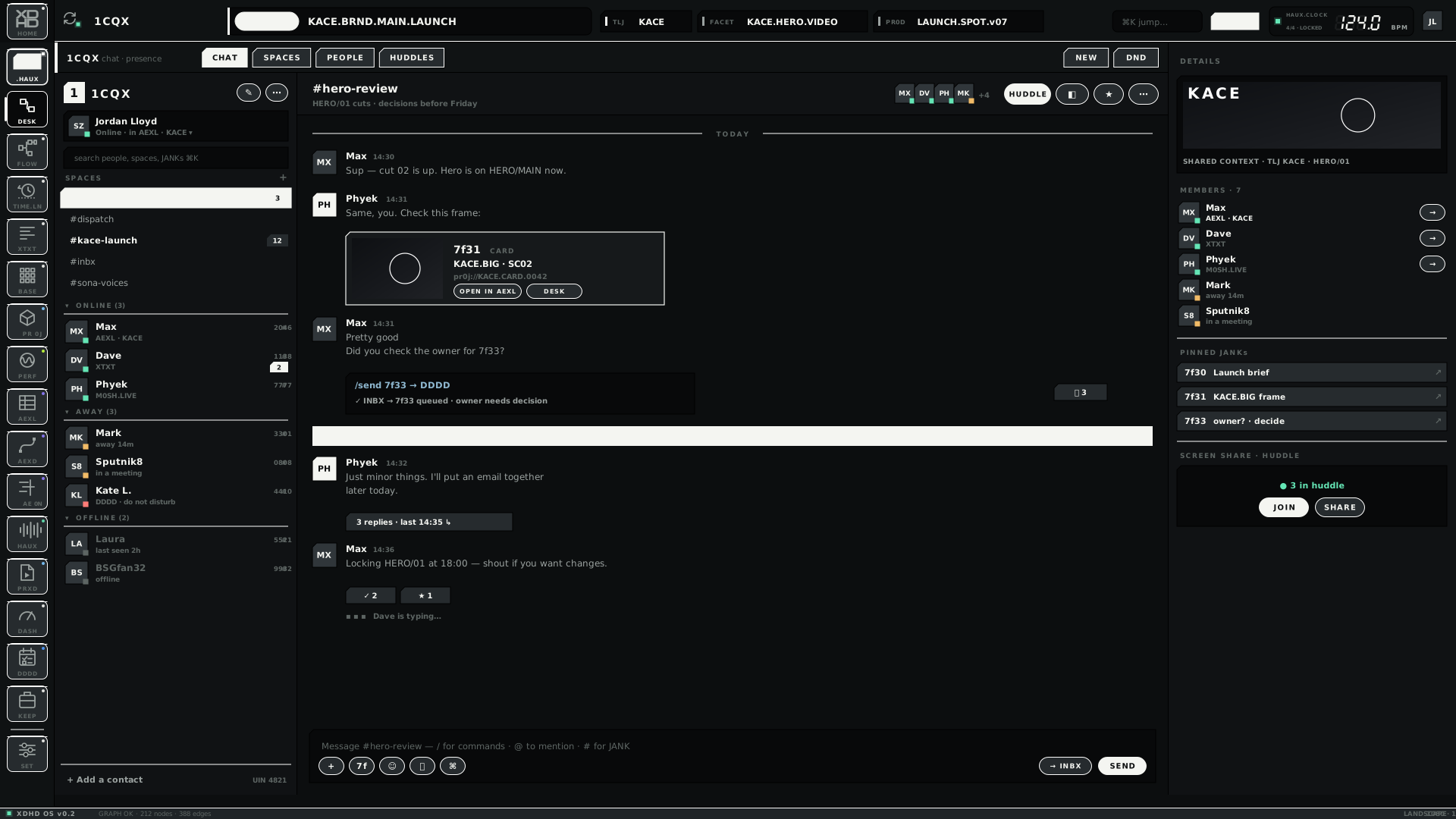
A navigable BLNK.XDHD workspace first. Refine the full UI, including XDHD.CHAT, then bring existing capabilities into that design one useful step at a time.
v0.10 is the updated design brief and implementation plan. It is not a release of a connected production application.
The next milestone
Review the intended product as one coherent, clickable environment. Keep the familiar interaction ideas from the existing workshops: context, navigation, linked selection, Hero, Inspector and project channels. Rework the presentation where needed, without assuming an old prototype can be translated directly.
The new UI establishes the structure. XDHD.Pro.Tools contributes existing capabilities through bounded adapters as the design settles.
EXISTING LOCAL PROTOTYPE
BLNK.XDHD workshop
Its documented scope includes 34 workspace routes, 128 HAUX landscape reference screens, source breadcrumbs, Back/Forward, linked selection and UI-only capture/conversation controls.
These are workshop results reported in its README. They are not functionality installed in the working app or re-tested by this document.
DESIGN REVIEW
One continuous workspace
Review how project → production → shot → Compose connects to text, style, workflow, conversation and output. Selection and context should remain legible across surfaces.
Map the screen, its states and its exit before connecting a real writer.
FOLLOWING MILESTONE
Bring functions into the UI
Choose one useful capability, locate its existing CORE owner, define an adapter and verify that exact build on synthetic data. Preserve unavailable states until the host supports the action.
One kit, several expressions
Layer
Role in the intended UI
Current position
HAUX.OS
Base vocabulary for shell, context, components and interaction profiles.
Neutral workspace used to review the complete experience.
Standalone local workshop. No production backend is connected.
XDHD.OS / SRZA.OS
Configurations with domain-specific vocabulary and controls.
Existing artwork and experiments; rendered controls do not establish live capability.
XDHD.CHAT.CORE
Reusable conversation component; neutral BLNK and M1ND / 1CQX skins.
Working local vertical slice; native and shared remote integration remain open.
Visual baseline
Use the existing XDHD/HAUX brand UI standard v0: dark neutrals, off-white emphasis, hairlines and small purposeful colour. Readable fallback typography carries functional text. Chamfered shell chrome and softer content geometry remain deliberate choices.
The two canonical OS compositions remain references for specialist surfaces. This web document reflows on phones. BLNK has no independently ratified palette; exact typography and geometry remain provisional.
XDHD.CHAT = M1ND.1CQX
Put conversation in the final UI map now, including both a full chat surface and a project-specific window.
Verified local foundation
Local persisted messages, channels, one-level threads, scoped drafts and bounded search.
BLNK / PlaceboUI neutral skin and 1CQX / M1ND.XDHD variant over the same behavior.
Multiple same-origin embedded windows with layout save/restore and import/export.
Selected text or OCR transcription can enter an existing Syno.SPAR normalizer for proposal, diff and review.
Verified here against the component README and handoff dated 3 November; this page does not run that backend.
Include in the clickable prototype
Open Chat from the workspace and a selected project's context.
Select a channel, enter a thread, return to its conversation and retain context.
Compare full chat, embedded project window and collapsed rail/popover references.
Show a draft, a proposal review and an explicit disconnected or unavailable state.
Review 390px layout and keyboard navigation before a host integration.
Still pending: native XDHD.Pro / AE0N embedding, canonical project/layout round-trip, verified membership and access, live Synology transport and physical phone acceptance. Presence, calls, attachments, live colleagues and messaging/AI services must remain clearly marked as design proposals unless their real host is verified.
1CQX is the M1ND expression of the shared chat core. The archived 1CQX art informs window, rail and conversation patterns; its pictured controls are reference artwork.
Existing 1CQX landscape reference. Open the original SVG to inspect it.
Work in reverse: the UI prototype plan
01 / Map
Inventory screens, relationships and states from the workshops and the HAUX references.
02 / Navigate
Make every mapped screen reachable, with clear entry, exit and preserved selection.
03 / Refine
Review names, hierarchy, panels, chat and responsive interaction in the complete UI.
04 / Connect
Bring one existing capability at a time into the accepted shell and verify it.
Review routes
Journey
UI acceptance
Host boundary
Explore → project → production → shot → Compose
Breadcrumbs, selected object, Hero and Inspector agree; Back restores location.
Demo graph and in-memory edits until a canonical writer is accepted.
Text / capture → review → workflow
Original text survives; proposal and accepted state are visibly distinct.
Existing INBX owns source assets and receipts; no duplicate master store.
Project → Chat → thread → project
Project/channel context, draft and return path remain explicit.
Local mock messages only in the design shell; CHAT host adapter later.
Style / audio / performance → output
Each surface is reachable and describes useful preview and unavailable states.
No real renderer, DSP, plugin, device or publication success implied.
Physical device and native compositor acceptance remain separate tests.
Milestone acceptance
A complete, inspectable screen map with entry/exit paths and no unexplained dead ends.
Useful empty, selected, draft, loading, error and disconnected states where relevant.
Consistent shell, context and naming across the whole experience, including CHAT.
A recorded decision for each prior prototype: reuse its assets, adapt its interaction or rebuild the surface.
One prioritized capability with an existing owner, bounded adapter contract and exact-build test before real-data use.
Existing workshops and implementation sources
BLNK workshop: XDHD.OS.HAUX.Prototypes/XDHD.UIUX/blnk-workshop/README.md CHAT foundation: XDHD.CORE/XDHD.CHAT.CORE/README.md Transport boundary: XDHD.SPAR/SPAR.HOSTS/synology/docs/CHAT-CORE-HANDOFF-20261103.md
These are local project references, not published workshop links. This document does not expose their source trees, local data or services.
Keep the original design evidence
The HAUX.OS.V1 kit contributes tactile controls, chamfered keys, vertical spines, selection hatching, clock layouts, full and collapsed 1CQX, and desktop window relationships. Treat its mint colour as the SRZA music flavour, not a global accent.
The v0.01 document, dashboard and every dependency are preserved byte-for-byte. Their historical counts, measurements, plans and local command paths retain their original meaning; v0.10 does not recalculate or silently promote them to current app status.
What changed in v0.10
Made the design-first clickable workspace the next milestone, followed by gradual capability integration.
Added current CHAT.CORE / M1ND.1CQX foundation, prototype journeys and explicit integration gaps.
Clarified the monochrome baseline and the distinction between OS reference profiles and responsive web layouts.
Separated the current plan from the intact historical design-system evidence and added an inspectable original-kit gallery.
Added stable version navigation so both editions can be published together.